VitaminVitamin D3
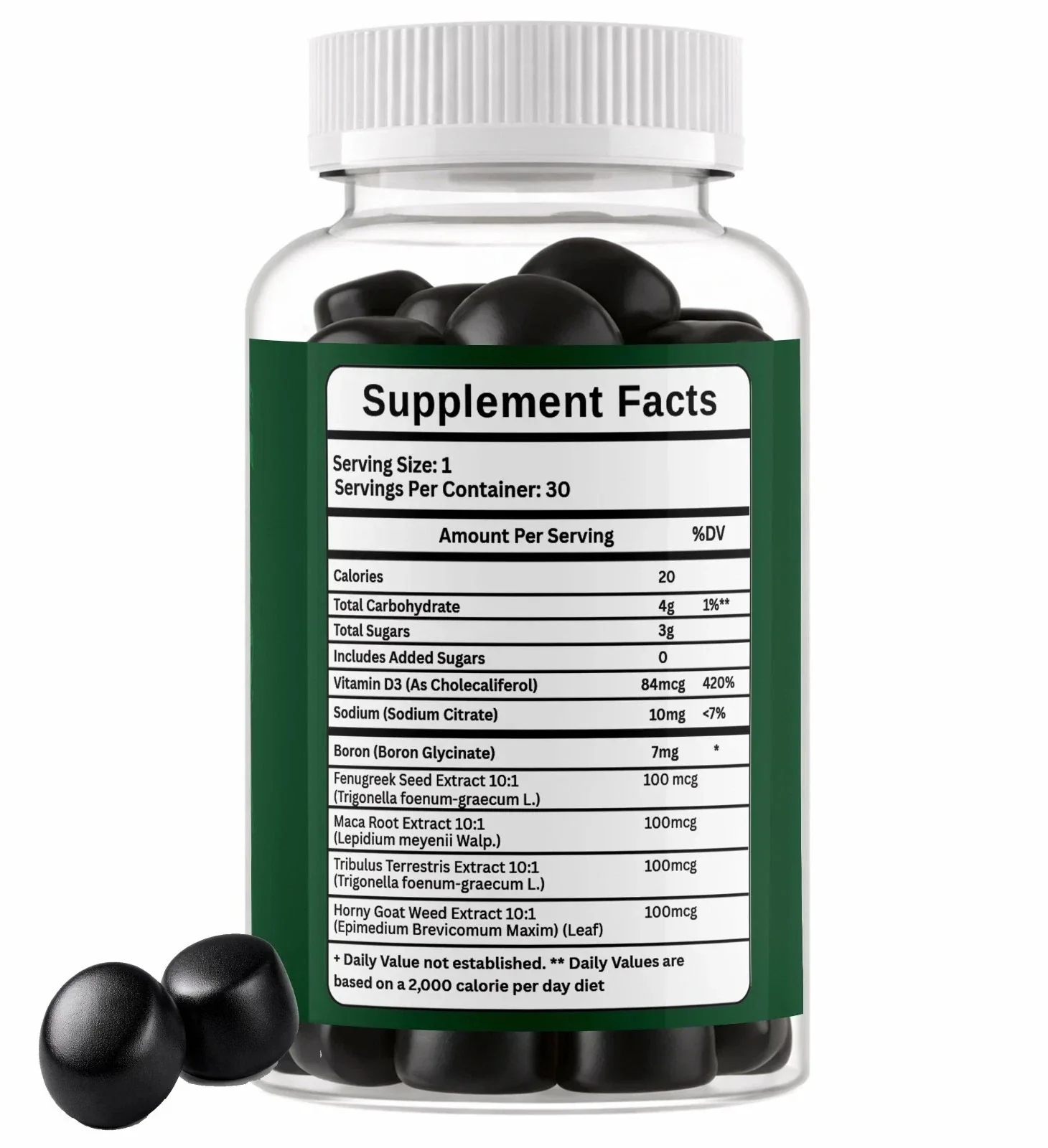
84 mcg in each gummy · cholecalciferol form
- This is cholecalciferol, the form your own skin produces in sunlight.
- That 84 mcg is 3,360 IU, a full 420% of the 20 mcg Daily Value.
- Most adults need 15 mcg daily, or 20 mcg after age 70. Across all sources combined, adults should stay at or below 100 mcg a day.
- Your body relies on it to absorb calcium and to keep bones and muscles working.
Watch for: Taking too much for a long stretch can push blood calcium up, which may show as nausea, weakness, confusion or kidney stones. Add up every vitamin D product you use. Reference: NIH Office of Dietary Supplements, “Vitamin D: Fact Sheet for Health Professionals”.
Trace mineralBoron
7 mg in each gummy · boron glycinate form
- Here the boron is bound to glycine, an amino acid.
- There is no Recommended Dietary Allowance for it. A typical adult diet supplies roughly 1 to 1.5 mg daily.
- Adults have an upper limit of 20 mg a day, so 7 mg sits at about a third of it.
- Small trials have looked at bone and hormone markers, and the NIH describes the evidence as limited.
Watch for: Nausea, vomiting and diarrhea come with very large doses. At 7 mg, you stay well below the limit. Reference: NIH Office of Dietary Supplements, “Boron: Fact Sheet for Health Professionals”.
Herb, 0.1 mgFenugreek seed, 10:1 extract
100 mcg in each gummy · Trigonella foenum-graecum L.
- Made from the seed of Trigonella foenum-graecum, a spice found in many kitchens.
- At a 10:1 ratio, around 10 parts of seed go into 1 part of extract, so 100 mcg stands for about 1 mg of seed.
- Research has focused mainly on blood sugar and breast milk supply, and studies in men used hundreds of milligrams.
- The amount here is smaller than a pinch of the spice.
Watch for: Usual doses can bring diarrhea, nausea or a body odor like maple syrup. During pregnancy, it is not advised beyond the amounts found in food. Reference: National Center for Complementary and Integrative Health, “Fenugreek: Usefulness and Safety”.
Herb, 0.1 mgMaca root, 10:1 extract
100 mcg in each gummy · Lepidium meyenii Walp.
- Comes from the root of Lepidium meyenii, a plant grown at high altitude in the Peruvian Andes.
- Long eaten as a food, and marketed for energy and sexual well-being.
- The small studies on it gave 1.5 to 3 grams of root powder daily.
- At 10:1, 100 mcg of extract equals roughly 1 mg of root.
Watch for: As a food, it is usually well tolerated. If you have a hormone-sensitive condition, check with a doctor first. Reference: Memorial Sloan Kettering Cancer Center, “Maca (About Herbs)”.
Herb, 0.1 mgTribulus terrestris, 10:1 extract
100 mcg in each gummy · shown with fenugreek’s Latin name, Trigonella foenum-graecum L. (a printing slip)
- Tribulus terrestris also goes by the name puncture vine.
- Commonly sold to men for vitality and testosterone support; this site does not make those claims.
- On this bottle, the tribulus line carries fenugreek’s Latin name, which reads as a printing slip.
- We have not reviewed a government or cancer-center summary on tribulus, so we say nothing about its effects.
Watch for: Talk to your doctor first, above all if you have a heart, kidney or hormone condition.
Herb, 0.1 mgHorny goat weed, 10:1 extract
100 mcg in each gummy · Epimedium brevicornum Maxim., leaf
- Taken from the leaf of Epimedium brevicornum, a plant with a long place in traditional Chinese medicine.
- Icariin is the compound it is best known for.
- Studies in people on sexual function or energy remain limited.
- At a 10:1 ratio, 100 mcg matches roughly 1 mg of leaf.
Watch for: Memorial Sloan Kettering notes dizziness, dry mouth and a fast heartbeat as possible effects, and advises people with heart disease to avoid it. Reference: Memorial Sloan Kettering Cancer Center, “Epimedium / Horny Goat Weed (About Herbs)”.