From the Military Honey journal
Micrograms vs. Milligrams on Supplement Labels: Why 100 mcg Is So Small
A microgram (mcg) is a thousandth of a milligram (mg), so 100 mcg works out to 0.1 mg. That is the amount the Military Honey label lists for each of its four herb extracts. Because they are 10:1 extracts, each one stands for roughly 1 mg of raw herb, well under the hundreds of milligrams, or even grams, that most herbal research uses.
Why the unit beside each number counts
Before anything goes live on this site, whether a page, a journal post, the bottle facts or the ingredient list, Dr. Judith Leone-Friedman reviews it. When you pick up a Supplement Facts panel, your eye probably runs straight down the list of ingredient names. Those names are the interesting part, yet they say the least about what you are taking. The figure and unit printed beside each name show how much is really in your serving, and that amount is what settles whether an ingredient has any chance of doing something.
Three units of weight turn up on supplement labels: grams (g), milligrams (mg) and micrograms (mcg, also printed as µg). Every step down that list shrinks the amount by a factor of a thousand. The rule is simple, but it slips the mind easily, since “100” reads as a large number whatever unit sits after it.
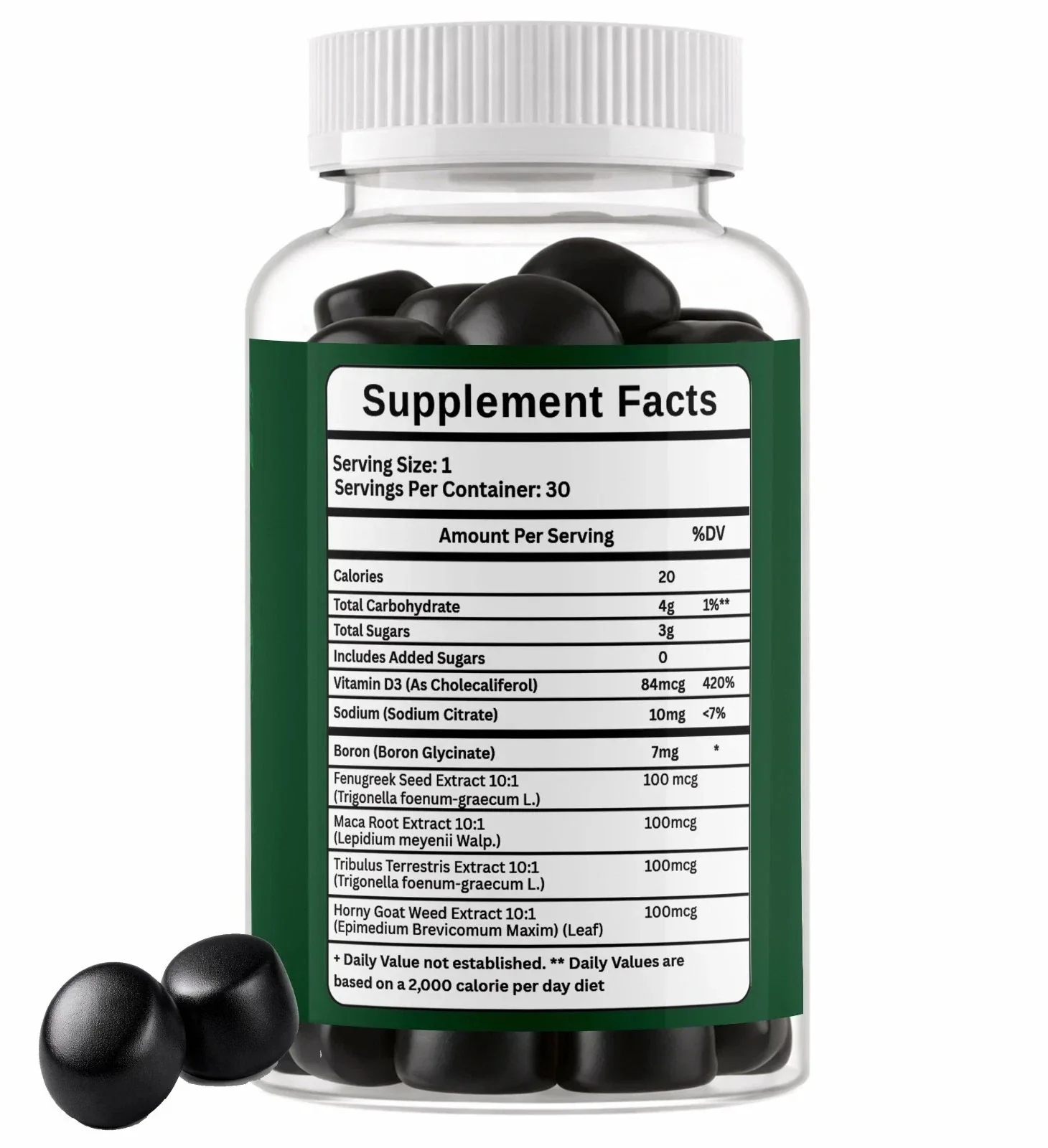
The Military Honey panel fits all three units onto one small label. Grams cover the carbohydrate and sugars, milligrams cover sodium and boron, and micrograms cover vitamin D3 plus the four herb extracts. Once you read each unit correctly, your sense of what the gummy holds shifts quite a bit.
Converting between units in one step
Keep one rule in mind and the rest follows: 1 gram = 1,000 milligrams, and 1 milligram = 1,000 micrograms. Put together, a single gram holds a million micrograms.
Going from micrograms to milligrams, you divide by 1,000. Going the other way, from milligrams to micrograms, you multiply by 1,000. Those two moves cover every supplement label you will read.
| Weight | In mg | In mcg | What it compares to |
|---|---|---|---|
| 1 g | 1,000 mg | 1,000,000 mcg | Roughly one small paper clip |
| 100 mg | 100 mg | 100,000 mcg | At or below a usual herbal capsule dose |
| 7 mg | 7 mg | 7,000 mcg | The boron in one Military Honey gummy |
| 1 mg | 1 mg | 1,000 mcg | Just a few salt grains |
| 0.1 mg | 0.1 mg | 100 mcg | Any one of the four Military Honey herb extracts |
Walking through the Military Honey panel, unit by unit
Start at the top of the panel and read each unit as you go. The label gives vitamin D3 as 84 mcg. By vitamin standards that is a large amount: the Daily Value is 20 mcg, so the panel shows 420%. Vitamins come in micrograms because your body needs only very small quantities of them.
Next comes boron at 7 mg, the same as 7,000 mcg. For a trace mineral, that is a real amount. Most adults take in about 1 to 1.5 mg a day from food, and 20 mg is the adult upper limit (NIH Office of Dietary Supplements, “Boron: Fact Sheet for Health Professionals”).
After that come the four herbs: fenugreek seed, maca root, tribulus and horny goat weed, listed at 100 mcg apiece. Seeing “100” beside them, you might assume they sit on the same scale as the figures above. In fact, 100 mcg of a plant extract is 0.1 mg, one tenth of a milligram.
| Nutrient or herb | Label amount | In mg | A big dose? |
|---|---|---|---|
| Vitamin D3 | 84 mcg | 0.084 mg | Yes, a big one for a vitamin (420% DV) |
| Boron | 7 mg | 7 mg | Yes, by trace-mineral standards |
| Fenugreek extract 10:1 | 100 mcg | 0.1 mg | No, for an herb |
| Maca extract 10:1 | 100 mcg | 0.1 mg | No, for an herb |
| Tribulus extract 10:1 | 100 mcg | 0.1 mg | No, for an herb |
| Horny goat weed extract 10:1 | 100 mcg | 0.1 mg | No, for an herb |
Micrograms for vitamins, milligrams for herbs
Vitamins, and a handful of minerals, are active in tiny quantities. An adult needs just 15 to 20 mcg of vitamin D daily and only a few micrograms of vitamin B12. So their doses appear as small figures in micrograms.
Herbs work on another scale. Most of a plant is fiber, water and everyday plant matter, and its active compounds make up only a small share. For that reason, herbal studies nearly always give doses of hundreds of milligrams, or grams. One chamomile tea bag, for comparison, contains about 1 to 2 grams of dried flowers, and maca studies commonly use 1.5 to 3 grams of root powder daily.
That makes the unit a clue in its own right. A plant extract printed in micrograms usually points to a small amount, the exception being a highly concentrated, standardized compound that has research of its own.
What the 10:1 on an extract tells you
On the Military Honey label, every herb is described as a . That ratio is a standard way to express concentration. Put simply, roughly 10 parts of raw plant went into every 1 part of finished extract.
By that measure, 100 mcg of a 10:1 extract lines up with about 1,000 mcg, or 1 mg, of raw plant. Some makers phrase this as “equivalent to” the bigger figure. Even counted that way, 1 mg of seed or root is an amount too small to see.
A ratio is not a measure of quality, either. The 10:1 figure describes how much plant was used, not how much active compound ended up in the extract. Certain extracts are “standardized” to a set percentage of a known compound, icariin in horny goat weed being one example. No standardization is stated on the Military Honey label.
| Plant | Printed dose | As raw herb (10:1) | Typical study amounts |
|---|---|---|---|
| Fenugreek seed | 0.1 mg | ~1 mg | Several hundred mg of extract daily |
| Maca root | 0.1 mg | ~1 mg | 1.5–3 g of root daily |
| Tribulus | 0.1 mg | ~1 mg | Several hundred mg daily |
| Horny goat weed | 0.1 mg | ~1 mg | Varies; little human data so far |
Setting a label beside the research
Using this idea does not require reading the studies yourself. All it takes is a rough sense of the amounts researchers used, set against the figure on the label.
NCCIH covers fenugreek studies on blood sugar and other uses (National Center for Complementary and Integrative Health, “Fenugreek: Usefulness and Safety”), and those studies measured their doses in grams of seed or hundreds of milligrams of extract. Memorial Sloan Kettering’s maca summary describes small studies built on grams of root (Memorial Sloan Kettering Cancer Center, “Maca (About Herbs)”). On horny goat weed, MSK points out that human research is still limited (Memorial Sloan Kettering Cancer Center, “Epimedium / Horny Goat Weed (About Herbs)”).
If a label’s amount sits a thousand times below what the studies used, those studies cannot tell you how the product will work for you. That does not show the product does nothing. It only means the research was done at a different dose and does not carry over to this one.
Find the unit
g, mg or mcg.
Convert to mg
Divide mcg by 1,000.
Spot any ratio
A 10:1 extract stands for roughly 10 times its weight in raw herb.
Look up the studied amount
Use a reliable summary, for example from NIH or MSK.
Set the two side by side
Does the label land inside that range, or well under it?
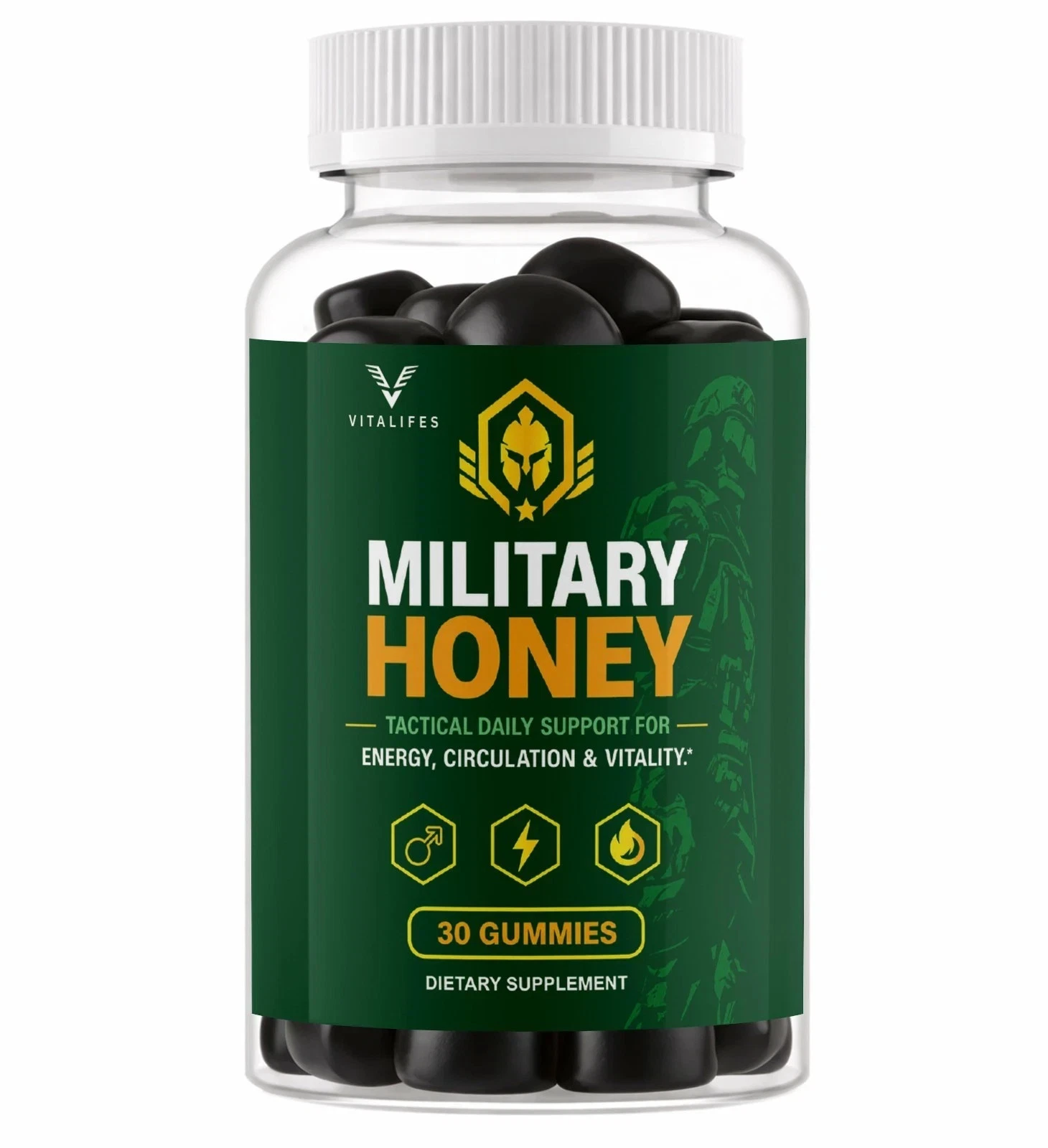
View every Military Honey pack and the full label.
See today’s priceHow tiny herb amounts end up on labels
Usually it comes down to a handful of practical reasons. Smaller amounts are cheaper to include. They also fit inside a gummy, where space runs short once the base, flavoring and sweetener are in. A gummy weighing only a few grams has no room for grams of several different herbs.
Keeping each amount small also leaves room to list more well-known herbs. Shoppers know names such as maca and tribulus, and spotting them on a bottle can feel reassuring. That is exactly why the unit beside each name deserves a careful look.
Listing small amounts is entirely legal. The label is transparent in that it prints every amount. Working out what those amounts really mean is left to you as the reader.
Where the numbers get big: vitamin D
With vitamin D, the units point the opposite way. As vitamins go, 84 mcg is a big amount. Adults have a Recommended Dietary Allowance of 15 mcg (20 mcg over age 70), and the upper limit, the highest daily intake most adults can take without risk, is 100 mcg counting every source together (NIH Office of Dietary Supplements, Vitamin D fact sheet).
That means a single gummy covers 84% of the upper limit. Add a multivitamin or a stand-alone vitamin D and your daily total could pass it. Two gummies would bring you to 168 mcg, so stay with the one-a-day serving on the label. You may also see vitamin D given in international units (IU): 1 mcg equals 40 IU, which makes 84 mcg the same as 3,360 IU.
Common unit mix-ups to avoid
- Reading “mcg” as “mg.” This makes an amount look a thousand times bigger than it is.
- Confusing IU with mcg. To turn a vitamin D figure in IU into mcg, divide it by 40, so 4,000 IU comes to 100 mcg.
- Taking “equivalent” figures at face value. An extract sold as “500 mg equivalent” might actually weigh just 50 mg.
- Skipping over the serving size. Each amount on the panel is for one serving, which here means one gummy.
- Leaving out your other supplements. An upper limit covers everything you take in a day, not just a single product.
Putting it all together
One microgram equals a thousandth of a milligram. Read that way, the four herbs on the Military Honey label come to 0.1 mg each, or about 1 mg of raw herb given their 10:1 ratio, well under what research has tested. At 7 mg, boron is a meaningful dose. Vitamin D is the big one at 84 mcg, close to the adult upper limit.
What matters most in this gummy, then, is the vitamin D and the boron rather than the herbs. Check each unit, add up the vitamin D from every product you use, and talk to your doctor if anything is unclear.
Sources
- NIH Office of Dietary Supplements. Vitamin D: Fact Sheet for Health Professionals. NIH ODS, current revision. Checked September 22, 2026.
- NIH Office of Dietary Supplements. Boron: Fact Sheet for Health Professionals. NIH ODS, current revision. Checked September 22, 2026.
- National Center for Complementary and Integrative Health. Fenugreek: Usefulness and Safety. NCCIH, updated February 2025. Checked September 22, 2026.
- Memorial Sloan Kettering Cancer Center. Maca (About Herbs). MSK integrative medicine database. Checked September 22, 2026.
- Memorial Sloan Kettering Cancer Center. Epimedium / Horny Goat Weed (About Herbs). MSK integrative medicine database. Checked September 22, 2026.
Questions on this topic
Anything else? The Military Honey FAQ has 35 answers.
How many micrograms are in a milligram?
1,000. So 100 mcg is 0.1 mg.
What amount of each herb does Military Honey contain?
Each 10:1 extract comes in at 100 mcg (0.1 mg), which is roughly 1 mg of raw herb.
Does 84 mcg of vitamin D count as a high amount?
Yes. That is 420% of the Daily Value, and it reaches 84% of the 100 mcg upper limit for adults.
How do you turn a vitamin D figure in IU into mcg?
Divide IU by 40. 84 mcg is 3,360 IU.
Start your daily Military Honey routine
Choose one, three, five or six bottles and the checkout shows your price before you pay. The money-back guarantee follows the terms printed on your listing. Questions before you order? The contact page explains which desk to use.
Sold by a USA authorized Military Honey retailer. This site does not make the product and earns when you order through its buttons.